Conversion
AI Chatbot vs Contact Form: Which Generates Better Leads?
Compare AI chatbots and forms by visitor needs, qualification, consent, verified delivery, running costs and useful lead-quality measurement.

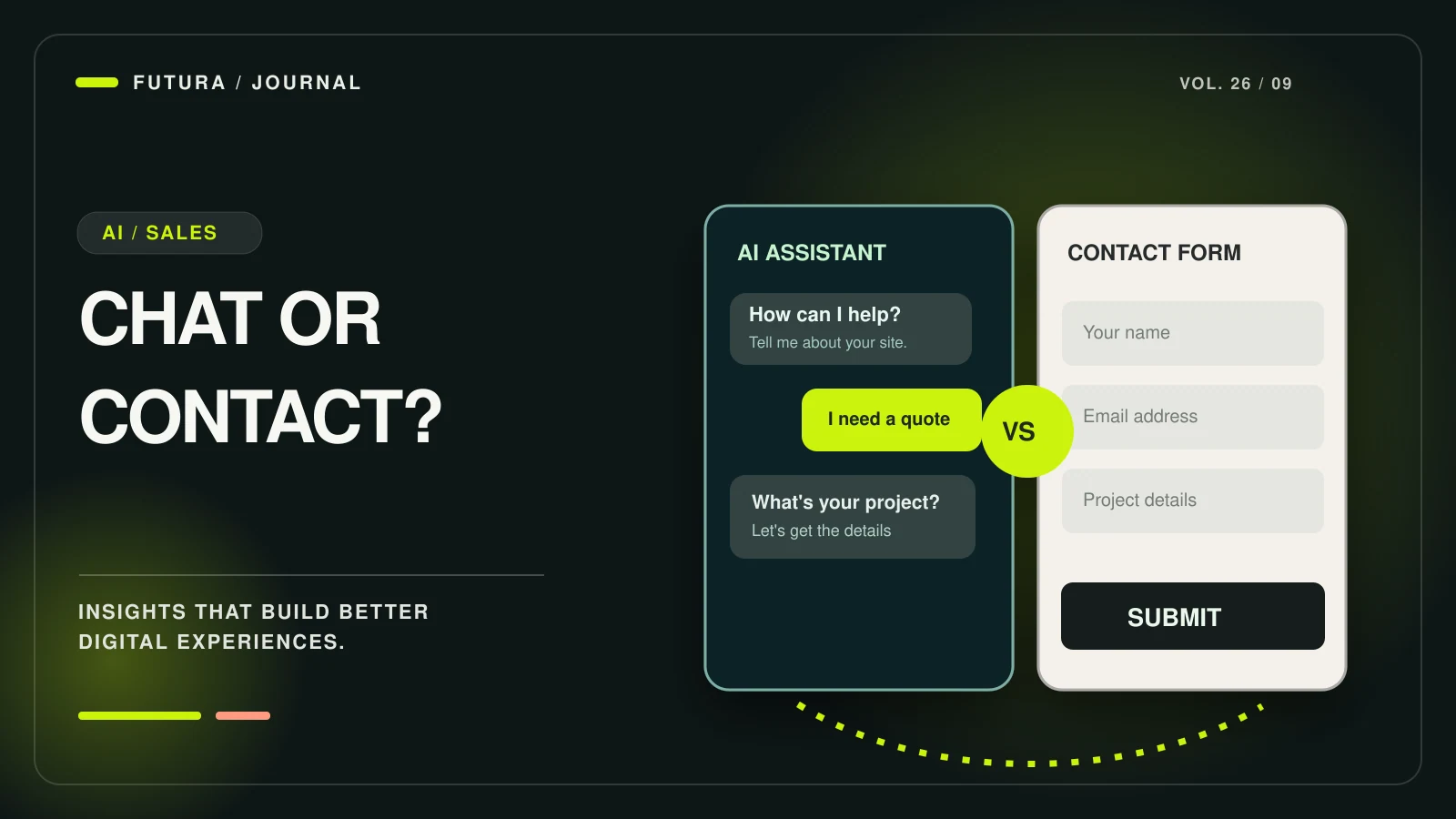
Neither an AI chatbot nor a contact form automatically generates better leads. A chatbot can help a visitor clarify an uncertain requirement; a form can collect a known requirement efficiently. Lead quality depends on the questions asked, the consent obtained, reliable delivery and what the business does next.
For many service businesses, the useful comparison is not “Which tool gets more interactions?” It is “Which journey produces enquiries our team can understand and serve?” A long conversation with no agreed next step can be less useful than a short form containing the right information.
A combined approach can work well: conversational guidance for people who need it, followed by a structured, consent-based enquiry. That is a design choice to test, not a claim that every website should add AI.
- A conversation is not the same as a qualified lead.
- Keep identity capture consent-based and separate from advice.
- Count verified acceptance and actual sales stages, not clicks.
Match the interface to the visitor’s uncertainty
A visitor who knows the project type, has a brief and wants a proposal may prefer a direct form. Asking them to repeat the same information through a chat sequence adds friction rather than value.
A visitor who is unsure whether they need a redesign, a new store or a booking integration may benefit from a guided conversation. The assistant can explain distinctions and ask one useful question at a time, provided it does not pretend to make decisions the business has not authorized.
| Situation | A form can help when | A chatbot can help when |
|---|---|---|
| Clear requirements | The visitor wants to send a brief quickly | They have one clarification before submitting |
| Unclear project | Structured choices are enough to orient them | They need help separating possible solutions |
| Pricing question | An accurate published policy answers it | Scope needs explanation without inventing a quote |
| Sensitive details | Purpose and required fields are explicit | The bot redirects details to a consent form |
| Operational handoff | Routing and acceptance are dependable | The conversation leads to the same reliable handoff |
Keep a direct alternative. A visitor should not be forced to converse with an AI system merely to contact a business.
Qualification is a conversation policy, not a chat bubble
Define what the business needs to know: project type, goal, current situation, relevant constraints and an appropriate follow-up route. Ask only what helps decide the next step. An assistant that requests country, budget, timing, industry and contact details in one response can feel like a form with extra reading.
Use one qualification question at a time and avoid asking again when the answer is already clear. “I run a company in Dubai and need an e-commerce website” establishes a business context and project type. It does not establish a budget, a deadline or the visitor’s nationality.
Keep visitor location, business country and target market separate if your operation uses them. A person connecting from the UAE may run a Moroccan business serving Saudi customers. An IP estimate must not overwrite information the visitor explicitly supplies.
Put limits around advice, prices and claims
An assistant should use approved business facts and a clear scope. It should not invent project estimates, delivery guarantees, offices, client results or available appointments. Route uncertain commercial commitments to a person who can assess them.
A price conversation should distinguish an approved starting point from a personalized quotation. Automatically converting one country’s starting price into another currency does not establish a legitimate offer for a different market.
Document the escalation rules. For example, redirect contact details into the consent-controlled form, explain that an enquiry is a request for follow-up and never claim that a meeting is booked unless the scheduling system actually confirmed it.
Separate availability from response promises
A chatbot can be technically available outside office hours, but that does not make the human team available at the same time. A form can accept a request around the clock too. The customer needs to understand what will happen after either interaction.
Do not publish a response-time promise unless the business can support it. Use honest status messages: the request was accepted, it could not be confirmed, or the visitor can try another contact route. Avoid “Our team is already working on it” when no such handoff has occurred.
Plan outages and limits. The visitor should still have a usable contact path if the AI provider is unavailable, a quota is reached or the conversation fails. A failure state is part of the experience, not an implementation detail to hide.
Design data handling before connecting a model
List what each provider receives: conversation text, contact details, campaign labels, operational metadata or payment information. Collect only what is needed for the task and explain the actual purpose and follow-up process.
A practical pattern is to keep free-text advice separate from identity capture. Ask for name, email or WhatsApp in a dedicated form with explicit permission to respond, not as an unbounded chat prompt. Do not include contact fields in model input merely because they are available elsewhere in the page.
Review storage, retention, processor arrangements, access and deletion responsibilities with appropriate advice. For Moroccan operations, CNDP website guidance is an official starting point. No widget, consent sentence or provider setting alone proves legal compliance.
Confirm delivery before counting a lead
A successful click is not a delivered lead. Nor is every resolved network request proof of storage: an opaque browser response cannot establish that a remote Sheet row was created. A dependable flow needs a defined acceptance boundary and a way to reconcile actual records.
For example, a lead-delivery design can treat explicit email-provider acceptance as the primary submission result while handling a spreadsheet as a secondary mirror. If the mirror fails after an accepted email, the visitor should not automatically be asked to submit again. The system should also avoid claiming that the mirror was verified when it was not.
Use a synchronous in-flight guard for repeated taps, validation for the expected fields and appropriate server-side protections. Browser-only throttling and a honeypot are useful layers but are not a durable abuse-prevention system.
Measure lead quality fairly
Define stages before comparing tools. Track interaction, consented submission, accepted delivery, qualification and the eventual commercial outcome separately. A chatbot may generate more conversations while producing fewer useful enquiries; a form may collect fewer but more complete briefs.
| Metric | A clear definition | A common mistake |
|---|---|---|
| Chat started | A visitor sends a meaningful first message | Counting opening the panel as a lead |
| Submission accepted | The agreed provider acceptance is verified | Counting any fulfilled request as success |
| Qualified enquiry | The team confirms fit using agreed criteria | Treating every email address as equally useful |
| Sales outcome | The real business record reaches a defined stage | Attributing revenue from a page visit alone |
Use comparable traffic and review the wording, placement and follow-up process. Do not assign an uplift percentage from another business’s case study to your own implementation. Keep tracking within the approved consent approach and avoid sending personal message content to analytics.
Include the ongoing implementation cost
A form needs validation, delivery, abuse protection and maintenance. A chatbot adds provider usage, instructions, error handling, evaluation and content governance. Someone must review whether replies remain accurate as services and policies change.
Start with a controlled set of test scenarios: an unclear requirement, a price request, a visitor volunteering contact details, a provider failure and a duplicate submission. Add examples in the languages you genuinely support. The Morocco agency-selection guide helps ask a supplier for this evidence rather than just a visual demo.
Choose the smallest useful journey
Use a direct form when the visitor can confidently provide the brief. Add conversational guidance when it resolves a genuine decision barrier and can hand off reliably. Keep both paths honest about acceptance, privacy and what the team can promise.
For stores and bookings, the operating journey is equally important: see our e-commerce launch guide and direct-booking guide. The right interface supports those operations; it does not replace them.
A conversion-focused landing page needs a dependable enquiry journey regardless of whether a chatbot is also available.
FAQ
Common questions
Does a chatbot always convert better than a form?
No. Test qualified outcomes with your audience and traffic. Interaction counts or another company’s uplift claim do not establish that it will produce better leads for your business.
Should a chatbot ask for every qualification detail immediately?
No. Ask one useful question at a time, preserve established information and collect only what helps the next step. Keep a direct form available for visitors with a complete brief.
Can the chatbot collect email and WhatsApp details?
Use a structured, consent-based capture process with clear data handling and verified delivery. Avoid sending those identifying details to the model when they are not necessary.
Is a thank-you-page view a confirmed lead?
Not by itself. Direct visits, refreshes and failed submissions can distort that signal. Tie the lead event to the agreed, verified acceptance boundary.
What should happen when the AI service fails?
Show an understandable error, preserve useful input where appropriate and provide another contact path. Do not claim a successful enquiry or a human response that has not happened.
Sources
Primary sources for the claims above, last checked on 2026-10-16.
- Website compliance guidance — CNDP
- Accessible forms — W3C WAI
Have a project in mind?
Plan a reliable lead journey
Share your goals and requirements with Futura. A team member can assess the scope; no automatic quotation or outcome is promised.
Discuss your project