Hospitality
How Hotels and Surf Camps Can Increase Direct Bookings Through Their Website
Improve hotel and surf-camp booking journeys with clear packages, usable integrations and verified outcomes, using factual Moroccan project examples.

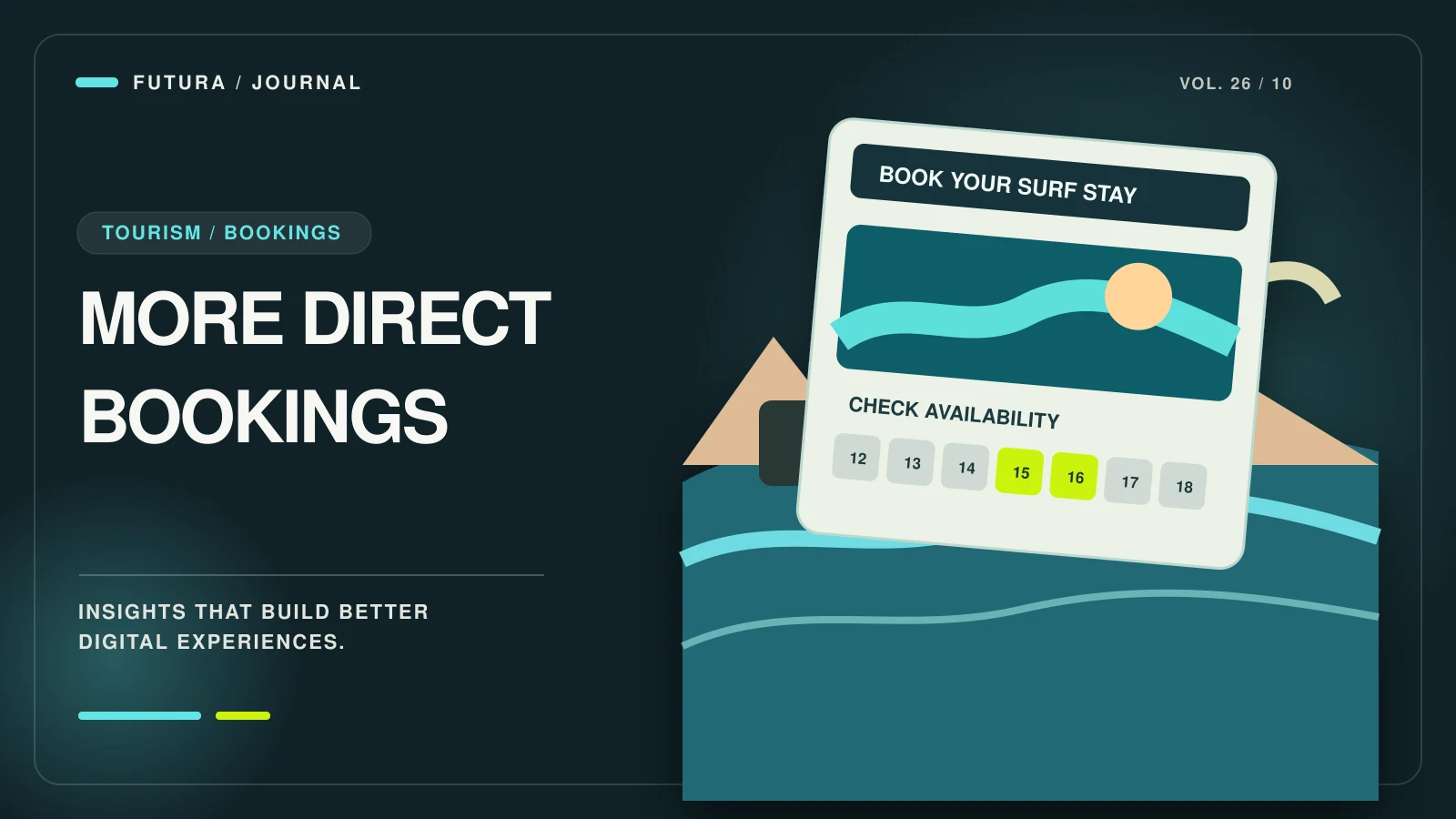
A hotel or surf camp can support more direct bookings by making the stay easier to understand, the price and conditions easier to evaluate and the reservation or enquiry easier to complete. The website must also connect to a process that genuinely confirms availability and handles the guest’s request.
This is not a promise that a redesign will produce a particular increase. Direct bookings depend on demand, distribution, pricing, availability and operations as well as the website. The useful question is where guests encounter uncertainty between discovering the property and receiving a confirmed next step.
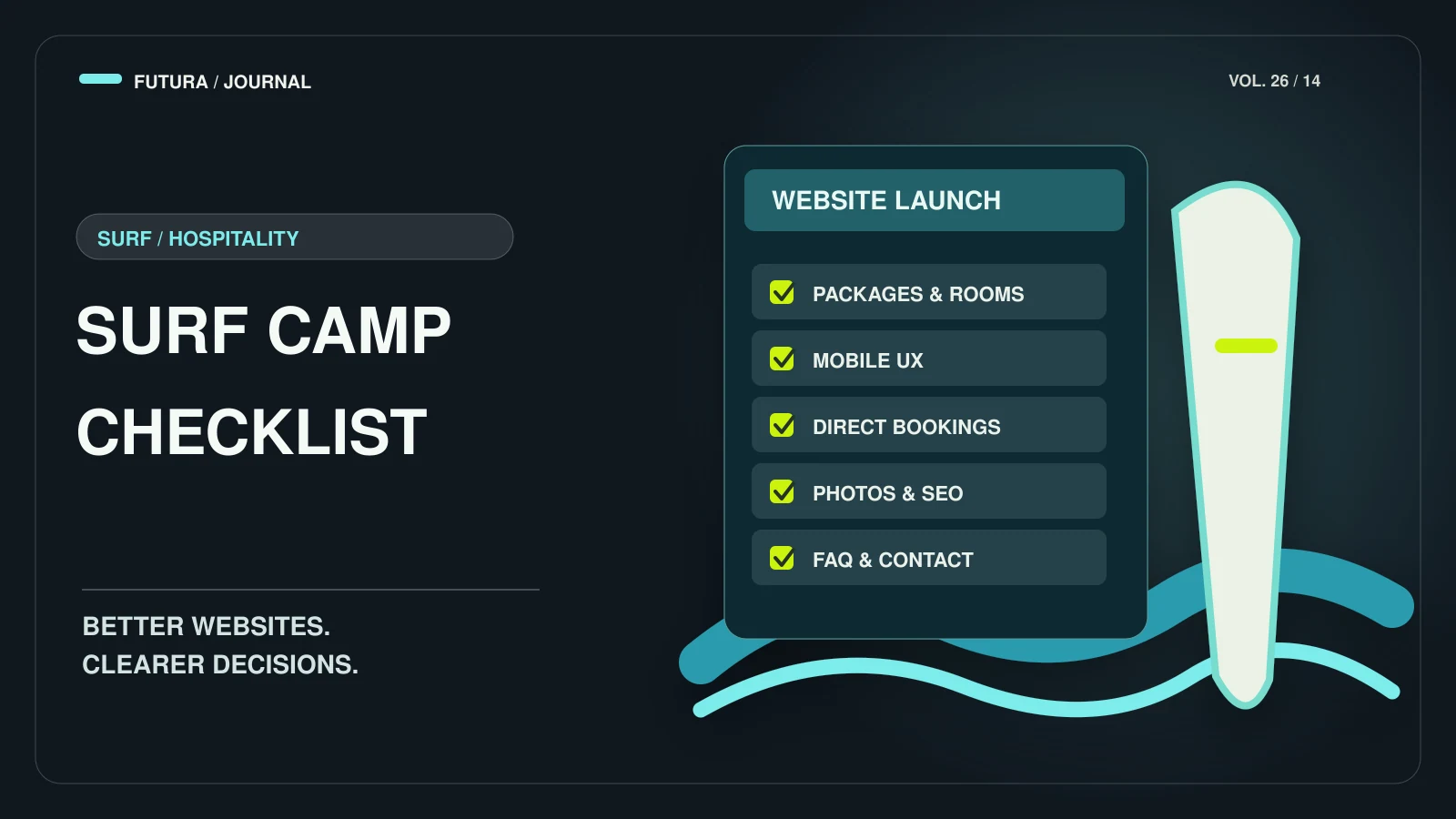
Our existing surf-camp website checklist covers the content inventory. This guide focuses on the decision journey, booking-system handoff and measurement that help turn that content into an operationally useful channel.
- Connect guest decisions to a truthful reservation or enquiry route.
- Test the external booking engine as part of the website journey.
- Use confirmed reservations rather than outbound clicks as booking outcomes.
Map the booking decision before editing the homepage
Write the guest’s main questions in order: Is this the right place for me? What is included? Are suitable dates available? What will it cost? What happens if plans change? How do I confirm?
A hotel room-only stay and a surf package involve different decisions. A surf guest may need to understand coaching level, included meals, transfers or equipment. A hotel guest may be comparing room occupancy, amenities and cancellation conditions. Do not force both journeys into the same unexplained “Book now” link.
Review real pre-booking questions from staff and guests, using information you are entitled to analyze. Repeated requests for basic package details are a signal to improve the page, not simply add another contact button.
Make rooms and packages comparable
Show the differences that change a purchase decision: occupancy, room or package type, inclusions, relevant restrictions and what is not included. Use accurate photographs and label what the guest is seeing. A beautiful atmosphere image does not explain which room or package is being selected.
| Guest question | Useful website information | Operational check |
|---|---|---|
| Is this suitable for my group? | Occupancy, ability level or relevant eligibility | Staff can support the described group |
| What is included? | Clear package and extra-cost distinctions | The offer matches the actual product |
| Can I travel on these dates? | Availability or an honest availability-request route | The authoritative calendar is maintained |
| What am I committing to? | Applicable price basis and booking conditions | Confirmation follows the stated process |
| What happens next? | Payment, enquiry or reservation steps | The guest receives the correct record |
Avoid presenting a “from” price without the conditions that make it applicable. If totals depend on dates, occupancy or options, help the guest understand that before they reach the final step.
Learn from public Futura project examples without inventing results
For SurfSunStay, Futura’s recorded scope covers a surf and hospitality website. Its public site describes surf and yoga stays, accommodation and experiences. The useful design lesson is to connect the stay being described to a clear enquiry or booking next step.
Futura’s work for Dar Surfana Morocco covers rooms, packages, experiences, enquiry/WhatsApp and SEO foundations. The public site lets a visitor explore the stay rather than treating the property as a single generic room product.
Those descriptions explain scope and visible patterns only. We do not have verified before/after booking data in this article and do not claim a conversion, revenue or occupancy improvement for either property. Public features and offers can change; check the live property site for current booking details.
Choose a booking journey your operation can support
A direct booking engine can be appropriate when availability, pricing and payment can be maintained reliably. A qualified enquiry can be appropriate for custom stays, groups or packages that need staff confirmation. The important point is that the interface tells the truth about what has happened.
A request for availability is not a confirmed reservation. A payment redirect is not necessarily proof that the booking record is complete. Agree which system is authoritative and how staff reconcile interrupted payments, duplicate requests and changes.
Before buying an integration, ask the provider to demonstrate the actual property workflow. Test the dates, occupancy rules, room/package selection, extras and cancellation process the business uses. Do not assume that a visually attractive widget supports those rules.
Keep the transition to an external engine understandable
Guests may move from the marketing site to another domain to check availability or pay. Preserve context: property identity, selected dates where supported and a clear explanation of the next stage. Avoid a link that lands on an unrelated generic search page.
Review the external experience on mobile. A polished website can still lose usability at a cramped date picker, an unclear currency display or a form that fails when the keyboard opens. Include the external journey in acceptance testing even when another provider maintains it.
Use provider-approved attribution and cross-domain measurement where appropriate and consented. Do not put guest names, email addresses or reservation details into campaign parameters simply to make analytics easier.
Use SEO to attract the right stay, not every travel keyword
Create useful pages for the property, rooms, packages and experiences that genuinely exist. Connect destination information to a stay decision: access, seasonal considerations, suitability and what the operation actually provides. Do not publish near-identical pages for destinations the business does not serve.
Keep business details accurate in relevant local listings. Our Morocco local SEO guide explains the difference between genuine local relevance and manufactured location claims.
Images should be useful, descriptive and appropriately sized. Google’s image SEO guidance is a technical reference; for the guest, the more immediate question is whether the photograph answers something important about the stay.
Measure completed outcomes and investigate the gaps
Separate booking-intent actions, submitted enquiries, accepted delivery and confirmed reservations. A click on “Check availability” is useful journey data, but it is not a booking. A thank-you-page refresh should not create another conversion.
Where a booking provider supports it, reconcile website measurement with an authoritative reservation identifier. Google’s purchase-event guidance illustrates the role of transaction identifiers; the implementation still needs to fit the actual booking system and approved consent approach.
| Journey stage | What to inspect | A possible improvement |
|---|---|---|
| Package interest | Questions and page navigation | Explain inclusions or suitability more clearly |
| Availability check | Date-picker completion and errors | Simplify the route into the correct engine |
| Enquiry | Validation, acceptance and staff routing | Remove delivery uncertainty and duplicate requests |
| Reservation | Provider-confirmed records | Reconcile attribution with genuine bookings |
Review changes with the property’s operating context. A change in available rooms, season or distribution mix can alter direct bookings independently of website design. Report those conditions rather than attributing every movement to the latest interface change.
Common mistakes that interrupt a direct-booking journey
- Using the same generic CTA for packages, room bookings and custom requests.
- Hiding inclusions, price conditions or cancellation information until late in the journey.
- Treating WhatsApp as proof that every enquiry was answered or converted.
- Measuring outbound clicks as completed reservations.
- Testing only the marketing pages and ignoring the external booking engine.
- Publishing guest reviews, photographs or results without appropriate factual support and permissions.
Improve one bottleneck before adding more features
Choose the most important stay or package, review the whole mobile journey and rehearse the booking or enquiry with staff. Fix one demonstrated point of confusion, then verify the operational result before expanding the work.
If a guided assistant is part of the plan, our chatbot-versus-form guide explains how to keep qualification, consent and delivery distinct. The website should help the right guest reach a dependable next step, whether that is a reservation or a useful conversation.
The web design service, hotel and riad industry page and surf-camp industry page provide related planning context for your own property and operating process.
FAQ
Common questions
Does every surf camp need instant online booking?
No. A clear availability enquiry may suit a custom package or group stay. Explain that it is a request, identify who follows up and avoid implying that a reservation is already confirmed.
Should we remove third-party booking channels?
This guide does not recommend a universal distribution strategy. Assess the property’s demand, costs and operations. Improving the direct journey does not require pretending other channels have no value.
Can a website redesign guarantee more bookings?
No. Demand, rates, inventory, seasonality and fulfilment all matter. Set measurable objectives and report actual evidence rather than promising a fixed uplift.
Are SurfSunStay and Dar Surfana results published here?
No commercial results are claimed. The examples describe Futura’s recorded project scope and publicly visible journey patterns, not verified before/after performance.
What should count as a direct booking conversion?
Use a confirmed reservation under the property’s actual process, ideally reconciled with an authoritative identifier. Track enquiries and availability clicks separately rather than labeling them all bookings.
Sources
Primary sources for the claims above, last checked on 2026-10-16.
- Public property website — SurfSunStay
- Public property website — Dar Surfana Morocco
- Google Images best practices — Google Search Central
- Purchase event setup — Google Analytics
Have a project in mind?
Review your booking journey
Share your goals and requirements with Futura. A team member can assess the scope; no automatic quotation or outcome is promised.
Discuss your project