E-commerce
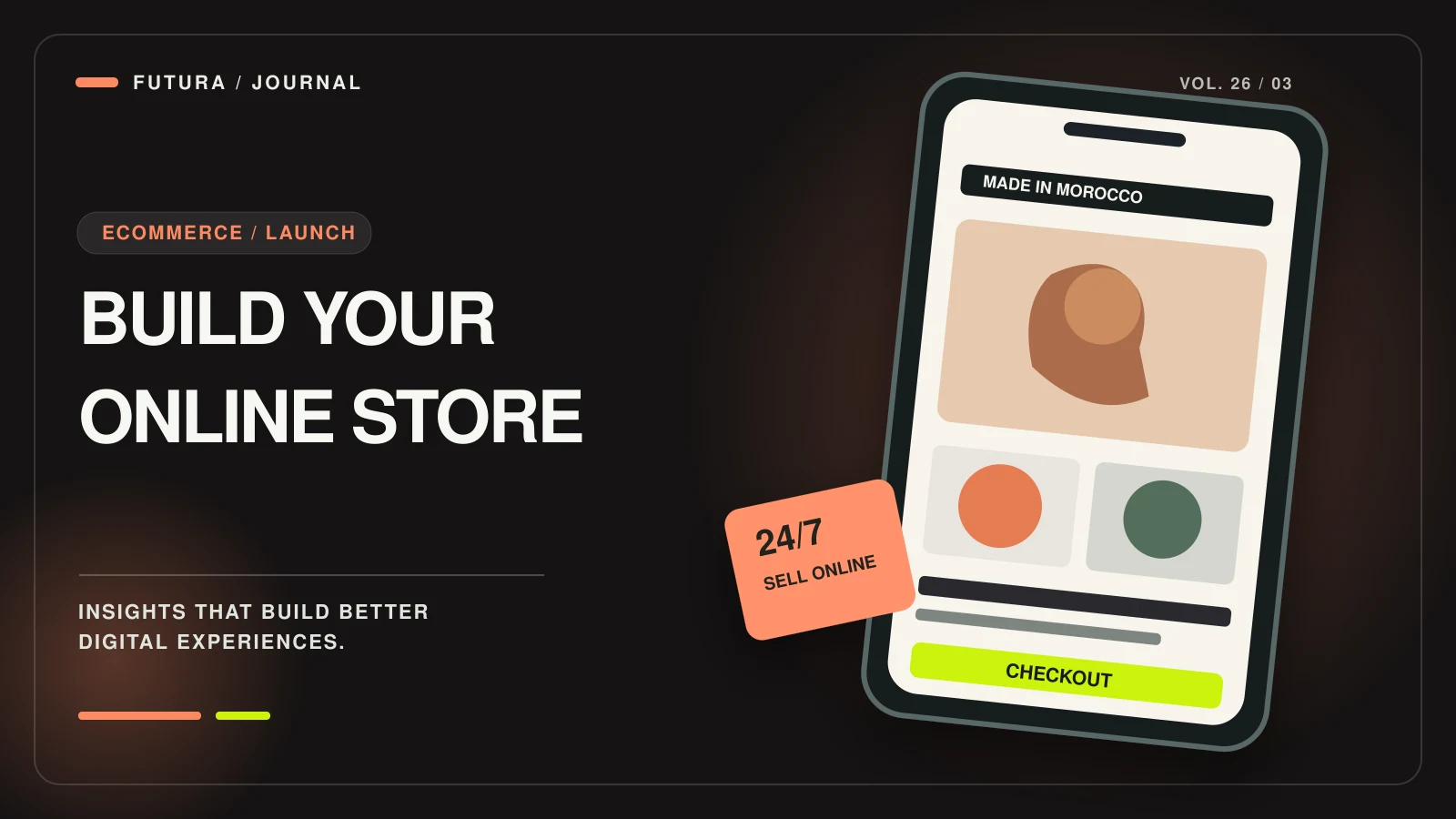
How to Create an E-commerce Website in Morocco: A Practical Launch Guide
Plan a Moroccan online store: compare Shopify and WooCommerce, verify payments, prepare products, shipping, mobile checkout and reliable order tracking.

To create an e-commerce website in Morocco, define the operating model before choosing the platform: what you sell, where stock lives, how payment is accepted, how orders are delivered and who handles returns. Then build and test the complete order journey on mobile, including failures and staff workflows.
The storefront is only one part of the system. A site can look ready while payment onboarding is incomplete, stock is inconsistent or nobody owns customer follow-up. Those gaps become expensive when paid traffic starts arriving.
This guide is for a Moroccan business preparing a genuine retail operation. Provider availability and legal obligations must be checked for the merchant’s entity, products and customers; a tutorial or a plugin listing is not evidence that an account will be approved.
- Confirm merchant payment eligibility before selecting the platform.
- Treat catalogue, checkout and fulfilment as one operating journey.
- Rehearse failures and verify orders before counting purchases.
Define the order you can actually fulfil
Start with a small representative catalogue. Document product identifiers, variants, stock quantities, prices, photographs, dimensions where relevant and shipping constraints. Decide whether stock is reserved at checkout, payment or manual confirmation, and identify the system that is authoritative.
Write the operational journey in plain language: the buyer places an order; payment is confirmed or fails; stock is updated; a staff member prepares the parcel; tracking is sent; a cancellation or return follows an agreed procedure. Assign an owner to every transition.
For an illustrative ceramics retailer, fragile packaging, variant photographs and damage handling may matter more than a complex loyalty program. For made-to-order furniture, lead-time communication and delivery-area confirmation may require a different purchase journey. These are planning examples, not claims about Futura clients.
Shopify or WooCommerce: start with payment compatibility
Shopify offers a hosted commerce environment; WooCommerce uses WordPress and a separately managed hosting and extension setup. Either can be suitable, but the payment, fulfilment and editing requirements should drive the comparison.
| Decision | Hosted commerce | WooCommerce |
|---|---|---|
| Infrastructure | Platform-managed core hosting | Hosting and updates need an assigned owner |
| Custom workflows | Evaluate platform and app constraints | Evaluate extension quality and maintenance cost |
| Payment provider | Verify supported merchant-country integration | Verify the gateway extension and update support |
| Operations | Test staff tasks in the actual plan | Test staff tasks with the proposed extension set |
| Long-term cost | Subscription, apps and payment-related charges | Hosting, extensions, maintenance and payment charges |
Do not select a platform on the assumption that a payment method available abroad will work for a Moroccan merchant. Shopify’s gateway-availability guidance directs merchants to its current provider listings. Confirm eligibility directly with the payment provider before committing to a build.
Verify Moroccan payment options directly
CMI publicly describes an e-commerce payment offering for merchants. That establishes an available provider to investigate, not automatic approval, a guaranteed fee or compatibility with every store configuration. Use the CMI merchant offering to begin a direct discussion about onboarding, settlement, integration, refunds and support.
Ask each shortlisted provider about the legal entity and bank-account requirements, accepted card types, settlement currency, fees, refund procedures and test environment. Request documentation for the exact platform integration. Do not enter card details into an improvised form or use a personal account as an undocumented workaround.
If you offer cash on delivery, treat it as a separate operating process. Decide how orders are confirmed, how refused deliveries are recorded and how cash is reconciled. Offering another payment method is useful only if the business can fulfil and account for those orders reliably.
Build product pages that remove buying uncertainty
A product page should explain what is being bought, which option is selected, availability, the total price presentation and what happens after ordering. Use photographs that show relevant details, scale and variations. Avoid a single generic image for products whose finish or size differs.
Make shipping and return information accessible before checkout. If a delivery charge depends on city or parcel size, calculate or explain it early enough to avoid a surprise at the last step. A support channel should complement useful product information, not compensate for missing descriptions.
Prepare catalogue data in a controlled spreadsheet or source system. Test an import with a small sample, including accents, long names, unavailable variants and missing photographs. Fix the data structure before importing the entire range.
Design checkout for real mobile use
Keep required fields purposeful and visibly labeled. Explain validation errors next to the affected field, preserve usable input when a request fails and prevent repeated taps from creating duplicate orders. The W3C form-label tutorial is a useful baseline for accessible input design.
Test address entry with realistic Moroccan delivery details rather than assuming every customer uses the same address structure. Confirm a telephone number’s role in fulfilment and explain it to the buyer. Avoid collecting extra personal information merely because a template offers a field.
A successful redirect back to the website is not sufficient proof of payment. The order state should be reconciled with the provider’s documented confirmation mechanism. Ask the developer to demonstrate a failed payment, an abandoned payment and a repeated callback as well as a successful test order.
Treat shipping, privacy and consumer information as launch work
Agree coverage areas, delivery estimates you can substantiate, parcel preparation, tracking and return handling with your fulfilment partners. Rehearse a delayed parcel and an incorrect address. Your store should explain the operating policy that actually exists, not publish generic promises copied from another merchant.
For personal-data handling, consult the CNDP’s current website-compliance guidance under Morocco’s law 09-08. Review notices, collection purposes, processor arrangements and any notification or transfer formalities applicable to your operation with an appropriate adviser. The CNDP guidance is an official starting point, not a pre-approved privacy policy for your store.
Have qualified local advice confirm applicable consumer-information, distance-selling, invoicing and product-specific obligations before launch. We do not prescribe a universal returns period, tax treatment or legal checklist for every merchant; those depend on the actual business and applicable rules.
Measure orders, not only clicks
Define the events you need before installing tracking: product views, cart changes, checkout starts and confirmed purchases. A purchase should reflect a verified order/payment state, with a stable transaction identifier to prevent double counting. Do not label an unconfirmed network request as revenue.
Configure non-essential tracking according to the consent approach approved for the store. Do not place payment or personal customer details into analytics parameters. Use consented campaign attribution to compare traffic with completed and fulfilled orders, not only with add-to-cart activity.
Our chatbot-versus-form guide explains why acceptance, qualification and delivery are separate measurement stages. The Morocco cost guide helps include recurring operating work in the budget.
A launch rehearsal worth doing
- Place representative test orders using provider-approved test methods.
- Exercise payment rejection, cancellation and a duplicated confirmation.
- Verify order notifications, stock changes and staff access.
- Test city-dependent delivery, unavailable variants and a refund workflow.
- Review mobile accessibility, empty states, policy links and account ownership.
- Remove test data and confirm the production configuration only after approval.
Launch when a small complete journey works, not when every optional feature is installed. The best first version is one the team can operate, support and improve from actual order evidence.
The e-commerce development service and retail industry page describe related website needs; keep provider approval and fulfilment decisions in the project brief.
FAQ
Common questions
Can I use Shopify Payments automatically from Morocco?
Do not assume availability. Check Shopify’s current country/provider listings and obtain confirmation for the merchant’s legal entity and bank account. A store subscription does not guarantee payment-provider eligibility.
Does WooCommerce avoid payment onboarding?
No. A compatible extension connects a store to a provider; it does not replace merchant approval, a settlement account or the provider’s requirements.
Is cash on delivery simpler than online payment?
It removes one online-payment step but introduces order confirmation, cash reconciliation and delivery-refusal work. Compare the full operating process rather than only checkout setup.
Should I publish every product before launching?
Not necessarily. A controlled initial range can expose data and fulfilment issues earlier. Make sure the published items have accurate options, availability, imagery and delivery information.
How do I know whether a purchase conversion is real?
Tie it to a confirmed order/payment state and a unique transaction identifier. Verify actual order records during testing; a button click or thank-you-page visit alone is not enough.
Sources
Primary sources for the claims above, last checked on 2026-10-16.
- Merchant e-commerce payment offering — CMI
- Gateway availability — Shopify Help Center
- Website compliance guidance — CNDP
- Consumer rights under law 31-08 — Moroccan Ministry of Industry and Commerce
Have a project in mind?
Plan an operable online store
Share your goals and requirements with Futura. A team member can assess the scope; no automatic quotation or outcome is promised.
Discuss your project