E-commerce
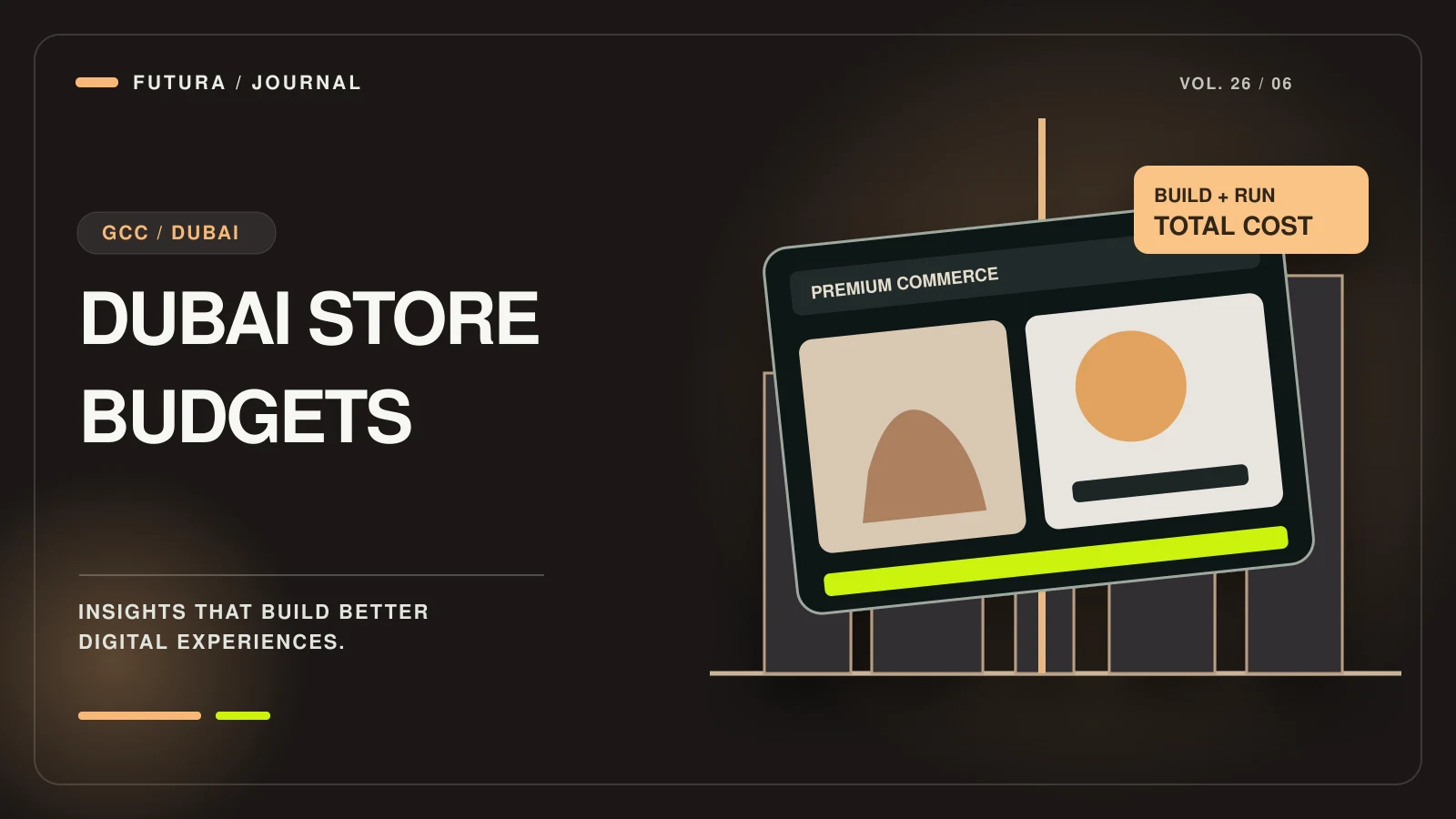
How Much Does an E-commerce Website Cost in Dubai in 2026?
Budget a Dubai online store by separating build scope, platform fees, Arabic UX, payments, integrations and ongoing costs, with a sourced example.

An e-commerce website budget in Dubai has two different parts: the project required to launch the store and the recurring cost of operating it. The platform subscription is only one line. Design, catalogue preparation, Arabic localization, payment onboarding, fulfilment integrations and maintenance can change the scope substantially.
There is no independently established universal Dubai build price in this guide. Published agency ranges describe those agencies’ offers and assumptions, not a verified market average or a Futura quotation. The useful comparison is a documented scope and a first-year operating model.
We use current supplier pricing below only where the supplier publishes it directly. Those figures are independent third-party charges, not Futura development fees, and must be rechecked before purchase.
- A platform subscription is one cost line, not a store quotation.
- Compare catalogues, localization and integrations at equal scope.
- Keep independent supplier pricing separate from Futura proposals.
Separate the initial build from the operating system
The build may include discovery, page design, theme customization, product imports, integrations, testing and staff training. The operating system includes subscriptions, payment-related charges, support, content maintenance and the people processing orders.
A small catalogue with supplied photography and a standard fulfilment process can be simpler than a store with few products but complex configuration, trade-account pricing or installation scheduling. Product count alone is not a dependable pricing model.
For an illustrative fragrance retailer, the important work might be variants, product photography, delivery information and a dependable mobile checkout. An illustrative distributor may instead need customer accounts, inventory synchronization and order approval. These examples describe different scopes, not fixed packages or project estimates.
A verified platform-price example
On 16 October 2026, Shopify’s UAE pricing page displayed Basic at USD 32 per month on monthly billing, or USD 24 per month on yearly billing. The same page showed additional payment-related charges and plan-dependent capabilities. The website’s selected country page and billing terms matter; do not assume every displayed figure is denominated in AED.
Using only the displayed annual-billing base rate, twelve months at USD 24 equals USD 288 before any other applicable costs. That arithmetic illustrates one subscription line, not the cost of an online store. It excludes design/development, apps, domain, merchant-specific payment charges, tax where applicable and operations. Promotions are not used as the permanent budget baseline.
Do not convert that figure into a claimed Futura price or a guaranteed AED charge. Obtain the supplier’s actual billing terms and your own agreed quotation. If another platform fits better, compare the same categories rather than comparing a subscription with an all-inclusive agency proposal.
Identify the decisions that change implementation effort
| Requirement | What makes the scope larger | What to ask the supplier |
|---|---|---|
| Design | Distinct product journeys and custom components | Which templates and interactions are included? |
| Catalogue | Inconsistent data, many variants or complex rules | Who cleans, imports and checks the products? |
| Languages | Arabic copy, RTL components and separate QA | Is the complete checkout journey localized? |
| Payments | Provider onboarding and custom order reconciliation | Which exact merchant integration is supported? |
| Operations | ERP, warehouse, POS or courier synchronization | Which system owns stock and order status? |
| Support | Ongoing changes and operational incidents | What is included after handover? |
Ask what happens when an integration fails. A demo showing data moving once does not establish how duplicates, cancellations, retries or reconciliation will work in production. The error path often deserves as much attention as the happy path.
Budget for payment and fulfilment as separate services
A payment gateway may have its own onboarding, recurring and transaction-related charges. Telr publishes a UAE pricing page; use the current provider terms and your merchant assessment rather than assuming a fee from another business applies to yours. This guide does not quote a Telr rate or guarantee account eligibility.
Check who receives settlement, how refunds are handled, which currencies are supported and how order status is confirmed. If a platform also charges for third-party payment processing, include that line separately so the quote does not hide one fee inside another.
Fulfilment adds another operating layer: coverage areas, pickup arrangements, packaging, tracking, returns and customer support. Obtain actual courier terms for the products and destinations involved. A premium storefront cannot compensate for an unclear dispatch or refund process.
Arabic, English and mobile UX belong in the budget
A bilingual store requires more than translating menu labels. Product attributes, search, error messages, transactional emails and customer support wording all need a coherent experience. If Arabic matters to customers, include native review and mixed-direction testing in the scope.
Our Arabic RTL UX guide explains the interface issues that can otherwise become late change requests. The Saudi website planning guide is also useful when a UAE business intends to serve Saudi customers, but commercial, provider and legal requirements still need country-specific review.
Test checkout on a phone with a real keyboard, long names and realistic delivery information. Include payment rejection and an interrupted session. “Responsive” should describe a usable purchase journey, not only a page that fits the screen.
Build your first-year comparison worksheet
Use this equation: first-year ownership cost equals agreed project work plus recurring services plus usage-dependent charges plus agreed support and changes. Keep the billing currency of each line visible. Do not mix monthly and annual figures or treat a promotional period as the normal renewal cost.
Request the underlying assumptions: planned catalogue size, languages, staff access, integration scope, expected order handling and what happens if usage increases. Separate mandatory launch work from optional improvements that can be commissioned after the operating process is stable.
For a retailer moving from manual orders to checkout, a sensible first phase may be a focused catalogue, provider-approved payments and reliable fulfilment communication. For a business already selling through multiple channels, inventory accuracy and reconciliation may be the higher priority. Let those differences shape the proposal instead of choosing a price tier first.
Compare proposals and avoid misleading shortcuts
- Reconcile scope before comparing totals or advertised “from” prices.
- Request exclusions, third-party fees, billing currencies and tax treatment explicitly.
- Confirm ownership of accounts, customer data, source assets and licenses.
- Ask for acceptance tests covering payment failure, refunds and stock changes.
- Check whether post-launch support means defect correction, updates or new work.
- Reject guaranteed sales forecasts presented as a consequence of buying a website.
A proposal should explain how your store will operate, not simply how many pages will be designed. Keep a reserve for approved changes, but avoid using an undefined contingency as a substitute for discovery.
Decide what must be proven before launch
The first release should support a complete, testable buying journey that your team can run. Confirm payment eligibility, product accuracy, mobile usability and operating ownership before committing to optional features.
For a wider implementation sequence, our e-commerce launch guide explains the distinction between storefront, payment and fulfilment. Its Moroccan provider section is country-specific and should not be reused as UAE onboarding advice.
The e-commerce development service and retail industry page provide a useful starting point for describing the store’s actual scope.
FAQ
Common questions
Is a Shopify subscription the total cost of an e-commerce website?
No. It covers a platform plan under its terms. Design, implementation, apps, content, payment services, fulfilment and ongoing support may be separate costs.
Are the prices in this article Futura quotations?
No. The numeric example is an independent platform’s published subscription price checked on the stated date. Futura must assess requirements before providing a proposal.
Can I use a Moroccan website price to estimate a Dubai store?
Do not automatically convert a price from another market. Scope, language, integrations, merchant onboarding and operating requirements need their own assessment.
Why do two stores with the same number of products cost differently?
Variants, data quality, custom configuration, integrations and operational rules can matter more than product count. Ask suppliers to price the actual workflows.
Should I choose the cheapest payment provider?
Compare eligibility, settlement, refunds, integration reliability, support and total charges as well as the headline fee. A provider must fit the merchant and operating process.
Sources
Primary sources for the claims above, last checked on 2026-10-16.
- UAE pricing — Shopify
- Payment gateway pricing — Telr
Have a project in mind?
Scope your UAE store
Share your goals and requirements with Futura. A team member can assess the scope; no automatic quotation or outcome is promised.
Discuss your project