Web Design
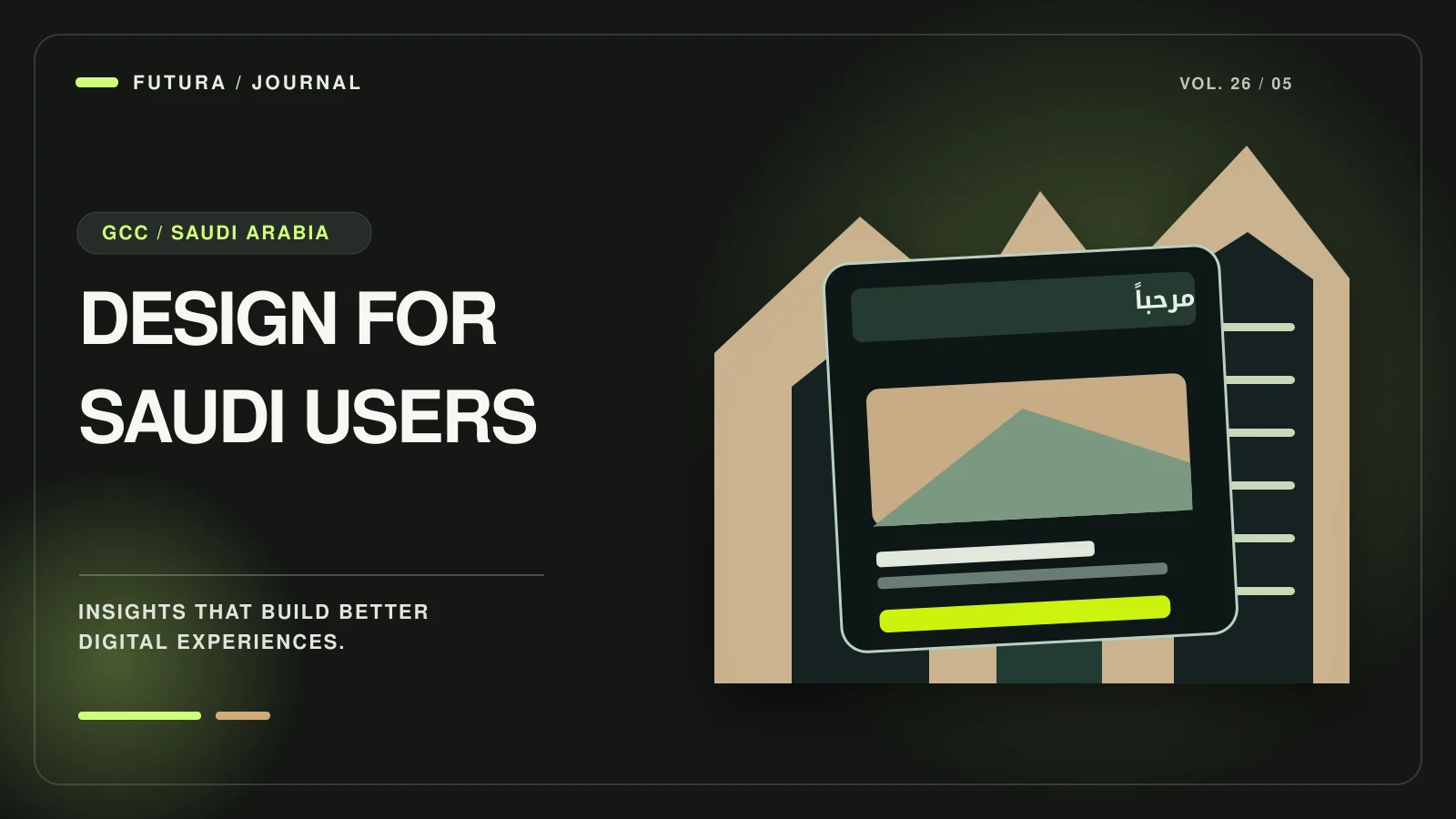
Website Design in Saudi Arabia: What Businesses Need in 2026
Plan a Saudi business website with complete Arabic/English journeys, mobile usability, trustworthy content, accessibility and dependable integrations.

A business website for Saudi Arabia should make its offer clear in the languages its customers use, work comfortably on mobile and connect visitors to a dependable next step. Arabic localization, trust information and operational readiness belong in the brief from the beginning rather than being added to an English design at the end.
There is no single “Saudi website style.” A professional-services firm, a local retailer and a tourism operator have different audiences and journeys. Start with the people making the decision, the information they need and the action your team can genuinely support.
Use this guide to prepare a brief with clear language requirements, accountable reviewers and testable customer journeys. Have the commercial, provider and legal requirements checked for the actual business before committing to a launch.
- Scope complete language journeys, not translated headings alone.
- Make trust, mobile usability and operations acceptance criteria.
- Use country-specific provider and legal review without invented local claims.
Define the audience before selecting languages
Identify whether you are addressing local consumers, procurement teams, international partners or several groups. Ask which language each audience uses to evaluate the offer and complete the task. Do not infer a person’s preferred language or nationality solely from their IP country.
If Arabic and English are required, scope two complete content experiences. Navigation, product information, form labels, error messages and confirmations need review in both languages. Translating only the main headings leaves important decisions and failure states inaccessible.
Write a page inventory that includes utility content: contact details, policies, transactional messages, search results and empty states. Assign someone qualified to approve the Arabic wording and terminology for the industry.
Design the Arabic experience as a real interface
Arabic affects typography, reading direction and the behavior of mixed-language content. It is not simply an English layout with every element flipped. Brand names, product codes, telephone numbers and email addresses may behave differently from surrounding text.
The W3C directionality guidance explains the role of HTML direction attributes. Use semantic direction settings and test real content rather than manually inserting spaces or punctuation to make one screen look correct.
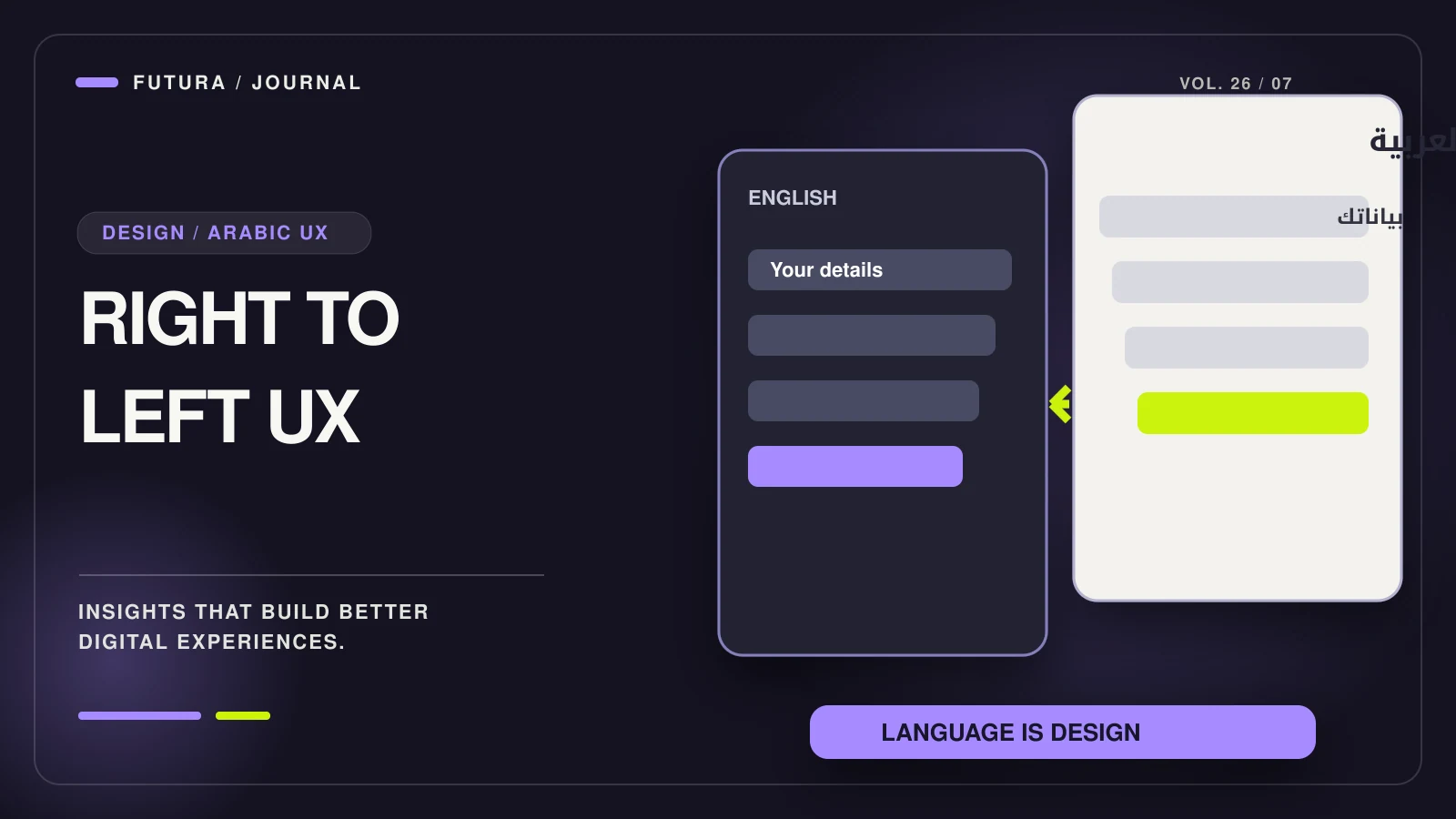
Our Arabic RTL UX guide goes deeper into mixed-direction forms, navigation and typography. In the project brief, the important requirement is that Arabic receives design and QA time equal to its role in the business.
Make mobile journeys complete, not merely smaller
A responsive page can still be awkward to use. Test whether a visitor can understand the offer, compare relevant information and contact the business without fighting overlapping controls, tiny inputs or an intrusive widget.
Use realistic devices and content. Long Arabic service names, bilingual labels, a mobile keyboard and an error message can reveal problems a desktop screenshot will not show. Keep the primary action accessible and avoid collecting information that the team does not need.
A practical B2B example is an enquiry form that asks for project type and a useful description, then confirms acceptance honestly. It should not pretend to schedule a meeting unless a real scheduling integration has completed that action.
Show trustworthy business information
Make the business identity, offer, contact route and relevant operating information easy to find. Use real project evidence and obtain permission before publishing customer names, logos or testimonials. Explain the scope behind a case study instead of presenting an unverified outcome.
For an online store, review Saudi e-commerce obligations using official sources and qualified advice. The Ministry of Commerce and the official E-Commerce Law publication provide a starting point for reviewing merchant information, customer communications and data handling. The obligations applicable to a specific entity or transaction should be checked rather than reduced to a universal website badge.
Do not publish a copied privacy notice or imply compliance because a template includes a policy page. Document what the website actually collects, which providers receive it and which person owns the review.
Treat performance and accessibility as acceptance criteria
Specify representative pages and complete tasks for QA: browsing services, switching language, submitting an enquiry, buying a product or checking availability. Test a reasonable range of mobile conditions and make sure the essential content remains usable if decorative effects are delayed.
Accessibility work should include keyboard navigation, visible focus, contrast, understandable controls, labeled inputs and useful errors. A compact visual design does not justify replacing field labels with disappearing placeholders. Use W3C’s accessible-forms guidance when discussing implementation requirements.
For deeper performance prioritization, see our Core Web Vitals guide. A good test report should explain the page and conditions tested, not present one score as proof that every customer will have the same experience.
Localize the conversion journey and integrations
Decide which customer action the site is designed to support and who owns the next stage. A callback request, WhatsApp message, checkout and booking-engine reservation are distinct outcomes. Each needs an appropriate confirmation and staff process.
| Journey | Information to settle before design | What to verify before launch |
|---|---|---|
| B2B enquiry | Qualification needs and follow-up owner | Accepted lead, correct routing and useful errors |
| Retail purchase | Catalogue, payment provider and fulfilment | Order state, payment confirmation and refunds |
| Booking | Availability source and reservation policy | Date selection, totals and actual confirmation |
| Branch visit | Genuine location and operating details | Useful directions and current contact information |
Confirm provider eligibility and integration requirements for the business entity. Do not assume that an account or payment method used in another country can simply be reused for Saudi operations.
Plan search visibility without duplicate language pages
Use a stable URL for each real language version, with correct canonical and reciprocal language references where corresponding pages exist. Keep drafts and unreviewed translations out of the public indexing plan.
Build service pages around distinct customer needs rather than repeating the same keyword with different city names. A Riyadh page should provide genuine Riyadh-specific information, not imply an office or local team that does not exist.
For AI-assisted discovery, the Google AI Search guide explains why crawlable, useful content remains more defensible than speculative ranking tactics. Search visibility should support a clear business journey rather than become an excuse for thin page production.
Common planning errors
- Treating Arabic review as a final translation task after design approval.
- Assuming every icon, number and form field should be mirrored.
- Using regional imagery or client logos that imply an unverified local presence.
- Installing tracking before agreeing data handling and consent requirements.
- Measuring enquiries without confirming actual delivery and follow-up.
- Accepting a launch date before content, provider onboarding and approvals are ready.
Prepare a brief that an agency can implement
List audiences, languages, conversion journeys, required integrations and evidence you can publish. Add an owner for content, Arabic review, legal review and operating support. Ask the agency to explain the trade-offs and demonstrate the critical journeys before release.
The result should feel appropriate to the business and its customers because the decisions were considered, not because the site repeats regional design clichés.
The web design service and corporate website industry page provide related scope context when preparing your own website brief.
FAQ
Common questions
Does every Saudi business need an Arabic and English website?
Language requirements depend on the audience, operation and applicable obligations. Evaluate those needs explicitly and obtain appropriate advice. If both languages are published, each should support the complete customer journey.
Is RTL support just a CSS change?
No. Semantic direction, mixed-language content, typography, navigation and input behavior all need review. A mirrored desktop screenshot is not sufficient testing.
Can a Saudi website use an international platform?
Potentially, if its editing, integration, payment and operating requirements are supported. Confirm provider eligibility and the entity’s obligations before choosing the architecture.
Will a Saudi city page prove we have a local office?
No. A website must describe the business accurately. Do not imply a physical office, staff or clients in a city without factual support.
Does Futura publish fixed Saudi website prices?
This article provides no Saudi price or automatic conversion from Moroccan pricing. A team member must understand the business requirements before preparing a personalized proposal.
Sources
Primary sources for the claims above, last checked on 2026-10-16.
- E-Commerce Law — Saudi Ministry of Investment
- Accessible forms — W3C WAI
- Structural direction — W3C Internationalization
Have a project in mind?
Plan a Saudi-market website
Share your goals and requirements with Futura. A team member can assess the scope; no automatic quotation or outcome is promised.
Discuss your project