Strategy
How Much Does a Professional Website Cost in Morocco in 2026?
Compare website costs in Morocco, understand Futura’s 5,000 MAD starting point, and plan content, CMS, hosting, maintenance and a clear quotation.

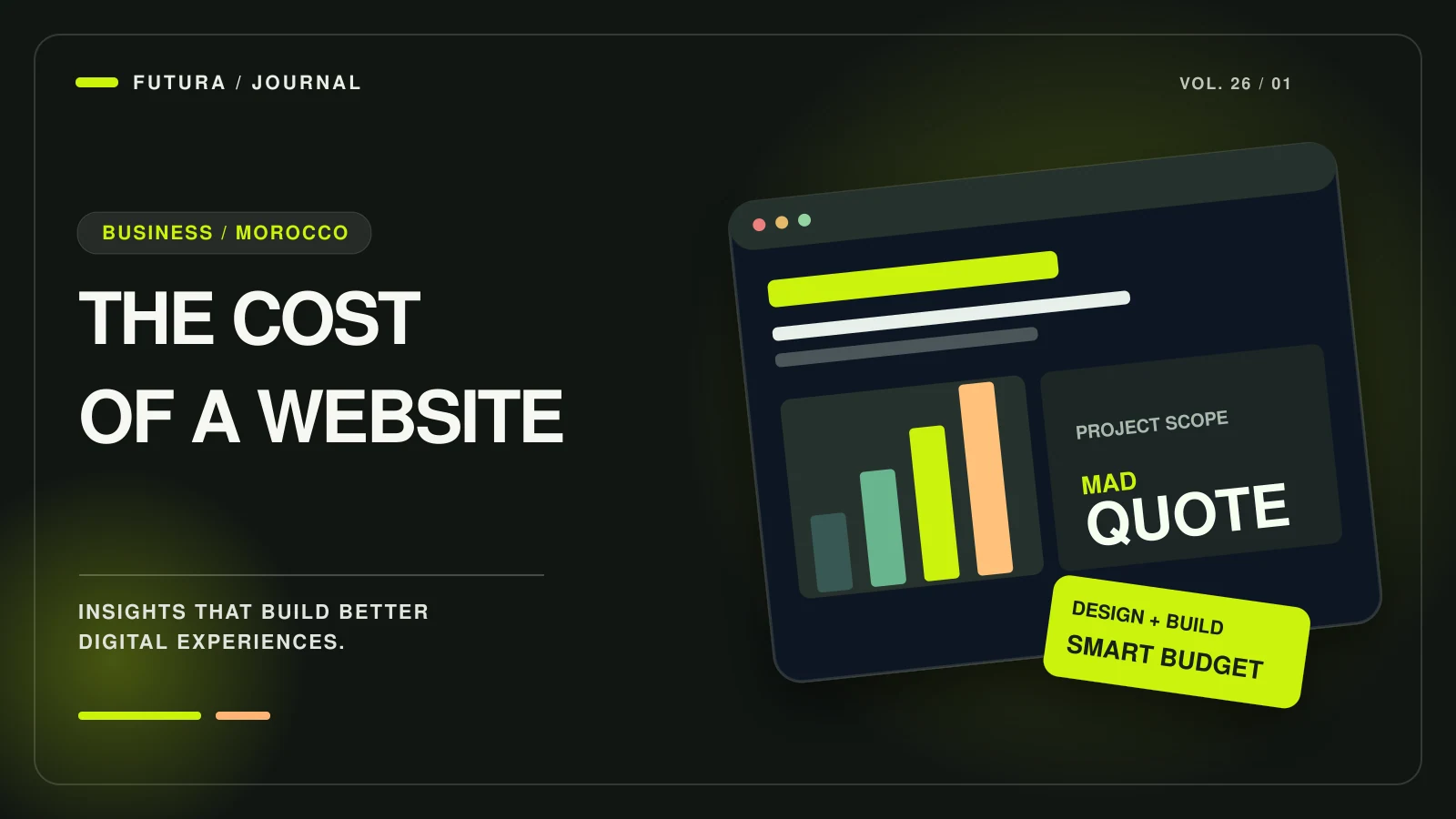
A professional website in Morocco should be budgeted from its scope, not from a universal market average. A small service-business website, a multilingual catalogue and an online store require different work. The most useful quotation separates strategy, content, design, development, integrations and ongoing ownership costs.
Futura’s approved Moroccan starting point is 5,000 MAD. That is a starting point for discussion, not a package promise, an e-commerce price or a personalized estimate. A team member must understand the requirements before proposing a scope and quotation. This guide explains how to make that conversation productive without relying on invented industry price ranges.
The mistake most likely to waste money is comparing two totals before checking what each supplier will deliver. A cheaper proposal can omit the work needed to make the site useful; a more expensive one can include complexity your business does not need.
- Separate the approved starting point from an actual quotation.
- Budget for content, integrations and first-year ownership.
- Compare suppliers using the same observable acceptance criteria.
What changes the price of a website?
Start with the job the website must perform. A Casablanca consultancy may need to explain three services and collect qualified enquiries. A distributor may need searchable product specifications, dealer access and an inventory feed. Both can be described as a “business website,” but their functional scope is fundamentally different.
Content is another major variable. Existing photographs, approved copy and a clean product spreadsheet reduce uncertainty. Asking an agency to interview your team, write pages, organize a catalogue and direct photography adds genuine work. Agree who supplies each input and when it becomes usable.
| Scope factor | A smaller requirement | A larger requirement |
|---|---|---|
| Content | Approved service copy and supplied images | Research, copywriting, photography and migration |
| Languages | One reviewed language | Separate content, navigation and QA for each language |
| Design | A limited reusable page system | Several distinct journeys and custom interactions |
| Operations | An enquiry sent to an existing inbox | Payments, stock, CRM or booking-system integration |
| Approval | One decision-maker with clear criteria | Multiple teams and compliance review |
A page count alone does not capture these differences. Ask for the main templates, data types and user journeys as well as the estimated number of pages.
Budget differently for each website type
A service-business website
A focused site normally needs a clear offer, useful service pages, genuine proof, contact details and a dependable enquiry journey. Spend first on understanding the customer’s decision and making those essentials work. A bespoke animation is optional; confirmation that an enquiry reaches the right team is not.
A catalogue or e-commerce website
A catalogue adds product structure and maintenance. E-commerce also adds checkout, payment approval, tax and delivery configuration, transactional communications, refunds and operational testing. Treat these as a separate scope rather than assuming they are included because a template has a shopping-cart icon.
For a more detailed operating plan, use our Morocco e-commerce guide. It covers the decisions that should be settled before platform selection.
A booking or custom business platform
A hotel booking engine, customer portal or custom workflow can involve third-party contracts and systems the agency does not control. Separate the website interface from the underlying operational system. Define which supplier owns availability, payment status, customer records and support when something fails.
CMS choices: compare ownership, not only setup
WordPress, Webflow, Framer and hosted commerce platforms have different editing models, hosting arrangements and extension ecosystems. A platform should match the work your team will do after launch: editing service copy, publishing articles, changing product variants or managing orders.
Ask the agency to demonstrate the exact editing task you expect to perform. Have someone on your team try it. An attractive editor does not prove that a complex product import or a multilingual update will be straightforward.
Account ownership matters as much as the technology. Know who owns the domain, hosting account, platform subscription, paid plugins, design files and source code. Record what can be exported and what must be rebuilt if you change suppliers. Our existing platform comparison examines that choice in more detail.
Build a first-year budget, not just a launch budget
A practical budget has three layers: the one-off project, recurring operations and a reserve for agreed changes. The recurring layer may include hosting or a platform subscription, domain renewal, paid extensions, maintenance, backups and content updates. Payment processing and transaction charges belong in an online store’s operating model.
Use actual supplier quotations in this worksheet. Do not fill it with guessed Moroccan market averages.
| Budget line | What to request in writing |
|---|---|
| Initial delivery | Included templates, content, integrations and acceptance tests |
| Recurring subscriptions | Billing currency, renewal period, account owner and exclusions |
| Maintenance | Update responsibility, backup restoration and support scope |
| Change requests | How extra work is approved and charged |
| Exit or migration | Handover assets, exports, credentials and termination arrangements |
For an illustrative consultancy brief, prioritize service copy, two or three reusable page templates and a verified contact journey. For an illustrative retailer brief, prioritize product data, payment compatibility and order handling before adding elaborate editorial features. These are examples of prioritization, not Futura quotations or fixed delivery packages.
Compare quotations against the same acceptance criteria
Give every shortlisted agency the same brief. Request a line-by-line explanation of deliverables, exclusions, responsibilities, taxes where applicable, billing milestones and what counts as a change. Ask which third-party fees are paid directly by you.
Then compare observable outcomes. Can the site be edited by your team? Are the important pages crawlable? Do mobile menus, forms and payment callbacks work? Is there a backup restoration process? Who handles a defect discovered after handover?
Avoid signing a proposal that promises “SEO included” without defining the actual tasks. Metadata, crawlability and a sitemap are useful foundations; they are not a guarantee of rankings, traffic or sales. Google’s SEO Starter Guide provides a sensible reference for technical discussions.
Common budgeting mistakes
- Choosing the cheapest total before reconciling scope and exclusions.
- Paying for a CMS your team cannot comfortably maintain.
- Treating copy, translation and product preparation as work that will happen automatically.
- Forgetting renewals, maintenance and payment fees after launch.
- Accepting accounts registered solely in a supplier’s name without an agreed handover.
- Buying a growth forecast presented as if it were a guaranteed website outcome.
Make the next decision a smaller one
Write a one-page brief covering your customers, primary conversion, languages, content readiness, integrations and decision-maker. Use it to obtain comparable proposals and identify the smallest complete scope that serves the business. Expand later when the operational foundations are proven.
If the next step is selecting a supplier, our Morocco agency-selection guide provides a practical interview and handover checklist.
Explore how Futura’s web design service approaches the website itself before requesting a consultation.
FAQ
Common questions
Is 5,000 MAD the price of every Futura website?
No. It is the approved Moroccan starting point, not a universal package or a personalized quotation. Content, functionality, integrations and support must be scoped before a team member can propose a price.
Is a template website always cheaper to own?
Not necessarily. Templates can reduce initial layout work, but unsuitable plugins, difficult editing, recurring licenses or a later rebuild can offset that saving. Compare the complete ownership model.
Should hosting and maintenance be included in the project quote?
They should be addressed explicitly, whether included or billed separately. Ask about renewal terms, account ownership, backups, updates and support responsibilities rather than assuming inclusion.
Can I phase the project to control the budget?
Yes, if the first phase is a complete usable journey. A service website can start with approved content and enquiry handling; a store still needs a dependable checkout and operating process before taking orders.
Does a higher price guarantee better SEO?
No. Ask for demonstrated technical work, useful content and a measurement plan. A higher fee does not guarantee crawling, indexing, rankings or qualified enquiries.
Sources
Primary sources for the claims above, last checked on 2026-10-16.
- SEO Starter Guide — Google Search Central
- About WordPress — WordPress.org
Have a project in mind?
Plan your website scope
Share your goals and requirements with Futura. A team member can assess the scope; no automatic quotation or outcome is promised.
Discuss your project